
 Mary Abbazia
 Tom Spitale
 Sean Welham
How even market leaders can drift from customer reality. How to avoid the fall.

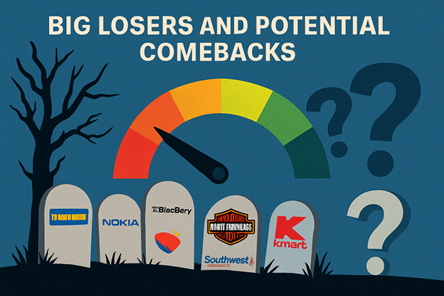
It’s easy to admire the companies that win. But the more revealing lessons often come from those that don’t. From Blockbuster and Nokia to Blackberry and Kmart, the business “graveyard” is filled with brands that once seemed untouchable.
They didn’t just fail to innovate. They failed to stay market aware.
At their peak, each of these companies was admired for being market-driving—anticipating customer needs and shaping the industries around them. But over time, they turned inward. The focus shifted from understanding customers to defending their own strengths. It’s a subtle but dangerous transformation that starts the slide from relevance to irrelevance.
1. The Fine Line Between Strength and Stagnation
Southwest Airlines believed its no-assigned-seating policy was a point of pride—an essential part of its brand DNA. But when research showed customers wanted to pay more for reserved seats and faster boarding, Southwest resisted. The same “strength” that once defined its advantage became a liability.
That’s the trap. A once-powerful differentiator hardens into dogma. Leaders hold onto what worked, even when customers have moved on.
2. Inside-Out Thinking: The Early Warning Sign

Every company exists somewhere on a spectrum—from inside-out to market-driving. Inside-out organizations define success based on internal priorities, structures, and habits. Market-driving ones constantly reorient around what customers truly value—even when that means questioning past successes.
When finance becomes the loudest voice, decisions start favoring short-term efficiency over long-term equity. When legal takes the lead, risk avoidance replaces boldness. And when management prioritizes protecting the product instead of listening to the market, the company stops learning.
3. The Comeback Pattern
Not every fall is final. Some companies find their way back. Harley-Davidson, for example, once set the gold standard for emotional connection with its customers. Today, it’s fighting to rediscover that edge. The key to a comeback is humility—the willingness to confront what changed and relearn what customers now want.
Southwest’s recent willingness to revisit its long-held policies is another encouraging sign. Redemption starts when leaders accept that their customers’ needs—not their own legacy—define the future.
4. Why Customer Centricity Is Harder Than It Sounds
True customer centricity isn’t just caring about customers—it’s caring enough to evolve. Many companies mistake product popularity for customer orientation. They assume that because people once loved what they made, they must be customer-focused. But being customer centric means continuously testing that assumption.
Tools like segmentation, trend analysis, and even AI-driven audits now make it easier to see whether a company’s story still aligns with what customers value. By analyzing how your messaging reflects attributes, benefits, and emotional drivers, you can quickly see whether you’re speaking the language of your market—or just talking to yourself.
5. Staying Out of the Graveyard
Avoiding decline isn’t about constant reinvention. It’s about disciplined curiosity.
Ask:
- Are we still solving the problems that matter most to our customers?
- Have new segments emerged that we’ve overlooked?
- Do our messages reflect customer benefits—or just product attributes?
- What trends are reshaping what “value” means in our category?
When you keep asking those questions—and acting on the answers—you won’t just avoid becoming a “big loser.” You’ll keep earning your place among the few companies that never stop driving the market forward.