
 Mary Abbazia
 Tom Spitale
Hidden in Plain Sight Series #3: One of the biggest growth opportunities isn’t building a better product—it’s recognizing that different customers value different things.

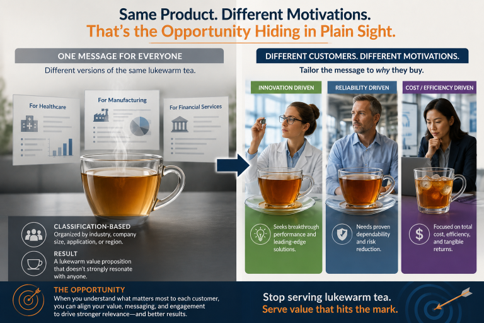
Imagine inviting two friends over for tea. One likes it piping hot. The other likes it ice cold. Trying to satisfy both, you serve it lukewarm. Neither is happy.
It sounds absurd, yet B2B companies do the equivalent every day. Most recognize that different customers require different conversations, so they create different presentations for different industries, company sizes, or applications. But those differences are often based on classifications rather than customer needs. As a result, they still average what truly matters most to buyers, creating a “lukewarm” value proposition that appeals strongly to no one.
In the process, they overlook one of the biggest opportunities hiding in plain sight: different customers often buy the very same product for very different reasons.
1. Growth Doesn’t Always Require Better Technology
When sales flatten, many leadership teams instinctively look toward engineering and R&D. Surely the answer is a more advanced product, a new feature, or breakthrough technology. Sometimes that’s true.
More often, the opportunity lies elsewhere. Companies frequently possess products capable of solving multiple business problems, and many already create different presentations for different industries, applications, or customer types. The problem is that these variations are usually organized around classifications rather than customer motivations. As a result, they’re often serving different versions of the same lukewarm tea—tailored to who the customer is, but not to why the customer buys.
The challenge isn’t always the product. It’s confusing customer characteristics with customer motivations.
2. Even Consumer Markets Reveal the Same Principle
Although our work focuses primarily on B2B technology companies, consumer markets often make strategic principles easier to see. Southwest Airlines provides a useful illustration before we turn to a B2B example.
For years, Southwest built its success around simplicity. Customers lined up, boarded in order, and chose whatever seat remained. Everyone was treated essentially the same. Eventually, research—and pressure from investors—forced a different conclusion. Some travelers were perfectly willing to pay more for certainty, preferred seating, or additional comfort. Others cared only about getting the lowest possible fare. Southwest responded by offering customers more choice instead of one standardized experience. Delta has taken personalization even further, allowing travelers to customize not only their seating but also many of the benefits bundled with their ticket.
Neither airline fundamentally reinvented air travel. They simply stopped assuming every customer valued the same thing. The same principle applies every day in B2B markets.
3. The Same Lesson Applies to B2B Technology
We once worked with a pharmaceutical company introducing a promising therapy for a life-threatening disease. The science behind the product was remarkable, so naturally the company emphasized the clinical data and novel chemistry in conversations with every physician. The response fell short of expectations.
When the company segmented physicians according to how they approached treatment decisions, a very different picture emerged. One segment loved discussing scientific innovation and clinical evidence. Another cared primarily about doing everything possible for seriously ill patients and responded much more strongly to patient-outcome stories than to scientific detail.
Equally important, the company identified physicians who were poor targets in the short term. Business-minded physicians worried about potential litigation surrounding a new therapy, while more conservative physicians—regardless of whether they were science- or patient-oriented—were reluctant to prescribe a drug with meaningful side effects until more experience had accumulated. The product never changed.
The company simply focused its efforts where adoption was most likely while allowing the market itself to build confidence over time. Once the messaging matched each segment’s motivations—and sales efforts concentrated on the right early adopters—the product became a commercial success.
4. Customer Motivation Reveals Opportunities Hidden in Plain Sight

Many organizations assume meaningful segmentation requires expensive market research and sophisticated analytics. It certainly can. But valuable insights often begin with something much simpler: asking customers what outcomes matter most to them.
One approach we’ve used for years is the Vietnam Card Sort. At the end of an ordinary sales call, a salesperson spends just a few additional minutes asking the customer to prioritize a handful of business outcomes and identify anything that’s missing. Those few minutes are like gold. After enough conversations, clear patterns begin to emerge. Customers who rank those benefits similarly often share remarkably similar buying motivations—even when they operate in different industries or geographic regions.
Instead of grouping customers by company size, geography, or industry, you’re grouping them by what drives their decisions. That’s where truly differentiated marketing begins.
Stop Serving Lukewarm Tea
Organizations become trapped inside their own expertise because they naturally assume customers view the world the same way they do. They don’t. Some customers prioritize innovation. Others prioritize reliability. Others care most about simplicity, financial return, operational efficiency, or reducing risk.
The companies that consistently uncover opportunities hiding in plain sight recognize those differences and have the discipline to act on them. Rather than averaging customer needs into one generic message, they tailor their products, communication, and customer experiences around distinct motivations.
The result isn’t necessarily a better product. It’s a much better fit between what customers value and how the company goes to market.
Related Posts
-
Watch the video below for a 1-minute summary of the post. Click here to view…
-

Hidden in Plain Sight Series #2: Customer insight is often hiding behind the technical features…
-
Why do companies develop products with little to no competitive advantage? Tom, Sean and Mary…