
 Mary Abbazia
 Tom Spitale
Hidden in Plain Sight Series #2: Customer insight is often hiding behind the technical features companies can’t stop talking about.
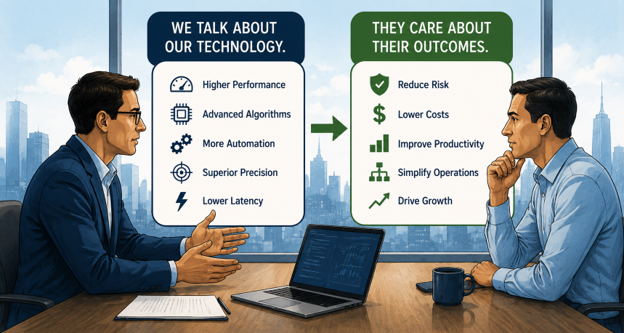
Walk into almost any B2B technology company and ask people to describe their products. You’ll hear about faster processors, greater precision, better algorithms, more automation, and superior performance.
Then ask customers why they bought. Their answers are usually very different. They talk about reducing risk, lowering operating costs, improving productivity, simplifying operations, or helping their business perform better.
That disconnect is what we call the Attribute Trap.
Organizations become so immersed in what their products do that they gradually lose sight of what customers are actually trying to accomplish.
1. Great Technology Doesn’t Automatically Create Customer Value
History is full of companies that built technically outstanding products but struggled because they communicated the wrong message.
BlackBerry emphasized secure email and its iconic keyboard just as customers were beginning to value the broader smartphone experience. IBM spent years leading with proprietary architecture while competitors increasingly spoke about flexibility and open systems.
Before Apple introduced the iPod, most MP3 manufacturers advertised gigabytes of storage. Apple famously translated the technology into a customer benefit: 1,000 songs in your pocket. The technology mattered. The benefit mattered more.
2. The Attribute Trap Is Alive and Well in B2B

We see the same pattern in technical industries every day. Engineers and technical salespeople naturally begin by describing specifications, features, and capabilities because those are the things they know best. Unfortunately, many of today’s purchasing decisions involve people who aren’t evaluating technology nearly as much as they’re evaluating business outcomes.
Procurement wants financial justification. Operations wants reliability. Executives want growth, profitability, and reduced risk. Even technical buyers increasingly need help building a business case for why a more expensive solution creates greater value. Simply saying your technology is better is rarely enough.
3. One Question Can Change the Entire Conversation
One of the simplest tools we use is also one of the most effective. Whenever someone describes an attribute or feature, we ask: Why is that important?
The first answer usually produces a functional benefit. Ask the question again and the discussion becomes operational. Ask it a third time and you’re often talking about business outcomes or strategic value. Without changing the product, you’ve changed the conversation. That’s how organizations begin communicating in language every stakeholder can understand.
4. Customer Insight Doesn’t Always Require Expensive Research
Many companies assume meaningful customer insight requires large research budgets and months of analysis. Sometimes it does. More often, it begins with better conversations.
One technique we’ve used for years, which we call “The Vietnam Card Sort”, asks customers to review a small number of potential benefits, identify what’s missing, and rank those benefits by importance. The exercise takes only a few minutes, yet it consistently reveals assumptions the company didn’t realize it was making and opportunities that had been overlooked for years. The opportunities weren’t hidden. The organization simply hadn’t been asking the right questions.
5. Start With the Customer’s Story—Not Yours
One client recently challenged its salespeople to tell the story of a solution without mentioning either the company’s name or the product. The exercise initially felt awkward. Then something interesting happened. Instead of describing products, salespeople began describing customer problems, failed attempts to solve them, and the outcomes customers hoped to achieve. By the time the solution finally appeared in the story – unnamed and unattributed to our client – customers were asking to hear more. The conversation had shifted from selling a product to solving a problem.

The Takeaway
Organizations rarely miss opportunities because they lack technical expertise. More often, they miss them because expertise narrows perspective. The companies that consistently uncover opportunities hiding in plain sight are the ones that spend less time asking, “What does our product do?” and more time asking, “What is our customer trying to accomplish?”
That’s where better conversations begin. And that’s where hidden opportunities are usually found.