
 Mary Abbazia
 Tom Spitale
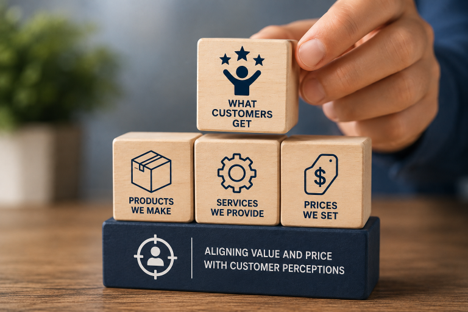
Opportunities Hidden in Plain Sight: Companies price what they make. Customers pay for what they get. Understanding the difference can transform both your value proposition—and what customers are willing to pay.
Most companies can explain exactly what they sell. An equipment manufacturer sells machines. A conference company sells registrations. An aircraft-engine manufacturer sells engines. And because those are the things appearing on the invoice, companies naturally build their value propositions—and often their pricing strategies—around them.
But customers see the transaction differently. They aren’t really buying your product. They’re buying what they expect to get from it. That distinction sounds obvious. Yet it can reveal some surprisingly valuable opportunities hiding in plain sight.
1. Sometimes the Opportunity Is Simply Charging What You’re Worth
We once worked with a company that ran sophisticated technical conferences. Like many organizations, it looked heavily at competitors when determining what to charge. Then we studied the situation from the customer’s perspective.
We assessed how attendees valued the company’s conferences relative to the alternatives. The answer was striking: customers believed these conferences delivered considerably more value than competing events—but the company’s prices didn’t reflect that advantage. So the company raised its prices by 33 percent.
What happened? It filled every available seat—and generated approximately $400,000 in additional profit. In retrospect, raising the price seems obvious. But without understanding customer-perceived value, management had little reason to believe customers would tolerate such a substantial increase.
That’s the danger of starting with the question, “What do competitors charge?” rather than “What is our offering worth to this particular customer?”
2. Sometimes You Need to Redefine What You’re Selling
Understanding customer value can lead to something more powerful than a price increase. It can change the value proposition itself.
Consider medical imaging equipment. Engineer Doug Dietz discovered that children were frequently terrified of MRI procedures. The intimidating machine, strange noises and confined space made an already stressful experience frightening. That wasn’t merely an emotional problem. Hospitals suffered economically as procedures took longer, children moved during scans, and appointments sometimes had to be rescheduled.
The obvious solution for an engineer might have been to redesign the MRI machine. Instead, Dietz helped redesign the experience surrounding it. GE Healthcare’s resulting Adventure Series transformed imaging rooms into adventures. Equipment could become part of a pirate ship or another imaginative environment. The underlying technology wasn’t necessarily the source of differentiation—the experience around it was.
Suddenly the value proposition wasn’t simply excellent medical imaging. It included making it easier for children, parents and hospitals to successfully complete the procedure. The product hadn’t fundamentally changed. What the customer got had.
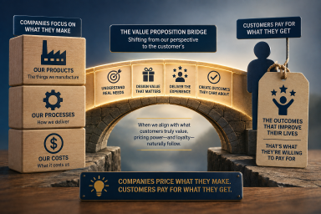
3. What If You Charged for What the Customer Actually Wants?
Rolls-Royce took this logic one fascinating step further. Airlines need aircraft engines. But owning an engine isn’t really the outcome they’re seeking. They want the airplane in the air.
Rolls-Royce recognized this decades ago with an approach known as “Power-by-the-Hour.” Rather than thinking solely in terms of selling engines and subsequently charging customers when those engines required service, its model evolved around charging according to engine flying hours. Think about how dramatically that changes the relationship.
When an engine is sitting because of an unscheduled maintenance problem, the airline isn’t getting what it wants. And Rolls-Royce isn’t benefiting from additional flying hours either. Both parties have an economic interest in the same outcome: keep that engine reliably flying. The pricing model itself becomes part of the value proposition.
4. Customers Don’t Care About Your Cost Structure
Pricing decisions frequently begin inside the company. What does the product cost us? What margin do we need? What are competitors charging? What did we charge last year? Those are legitimate business questions. But none answers the question the customer is asking: “Is what I’m getting worth what you’re asking me to pay?”
That’s why segmentation matters so much. Different customers can place dramatically different values on exactly the same offering. A price that looks excessive to one segment can look like a bargain to another because the problem you’re solving matters much more to them. The opportunity hiding in plain sight, therefore, isn’t always a new product.
Sometimes it’s recognizing that you’re providing more value than you’re charging for. Sometimes it’s surrounding an existing product with services and experiences customers value. And sometimes it’s completely reconsidering what belongs on the invoice.
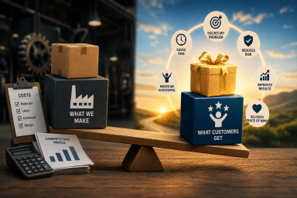
Because there’s a fundamental difference between how sellers and buyers see a transaction: Companies price what they make. Customers pay for what they get. The closer those two things become, the more powerful your value proposition—and your pricing strategy—can become.