
 Mary Abbazia
 Tom Spitale
 Sean Welham
Every few months, a headline makes the rounds asking some version of the same question:
- Is Gen Z unemployable?
- Are Millennials impossible to manage?
- Has Gen X fallen behind?
For marketers, this pattern should feel familiar, because it’s the same mistake companies make with customers all the time.
Broad labels are easy. They feel explanatory. But they rarely tell you what to do next.
That’s the insight behind a concept developed by Ginny Ertl, a change management specialist we’ve worked with for years and who collaborates with us on client engagements. She calls it “generationalization” — the habit of relying on generational classifications and mistaking them for meaningful insight.
It turns out that problem doesn’t just apply to workforces. It’s at the heart of why so many segmentation efforts fall short.
1. Classification Feels Like Segmentation — Until You Need to Act
Generational labels describe when someone was born. They don’t explain how that person approaches work, change, risk, or technology.
Marketing classifications work the same way.
Company size, industry, geography, revenue tier – these categories are easy to create and easy to communicate. But they rarely explain why customers buy, resist change, or value one solution over another.
Just as not all Gen Z employees fear AI, not all mid-sized manufacturers want the same outcomes. Classification creates buckets. Segmentation creates understanding.
2. The Same Insight, Applied Two Ways
Ginny’s work highlights a simple but powerful truth: when you look beneath surface labels, you find segments that cut across age entirely.
For employees, those segments show up as differences in motivation, risk tolerance, and how people relate to change. Some thrive on constant evolution. Others value stability and depth. Those patterns matter far more than birth year.
Now translate that directly to customers.
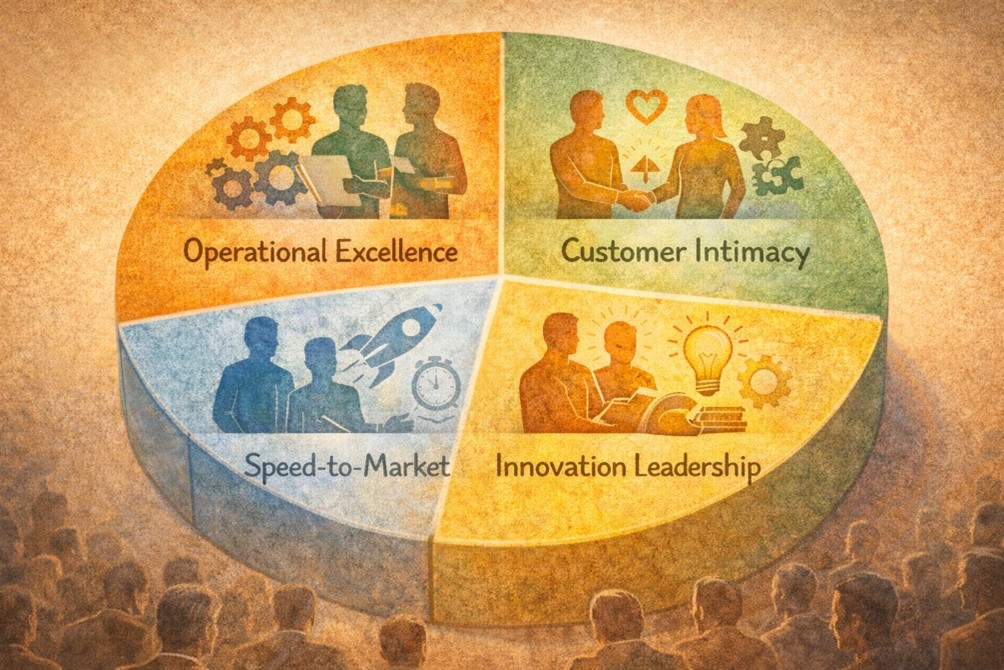
Some buyers want innovation leadership. Others want proven reliability. Some prioritize speed. Others prioritize control. These differences exist within every industry, company size, and geography.
If you rely on surface-level categories, you miss them. If you segment based on needs, motivations, and tradeoffs, strategy becomes clearer — and choices become easier.
3. Why This Matters in Practice
Several years ago, Ginny worked with a leadership team frustrated by employee turnover. They offered competitive pay, strong benefits, and a long list of perks designed to appeal broadly. Still, people kept leaving.
When they finally segmented their workforce, a pattern emerged. One group of high performers was always scanning for the next opportunity. That wasn’t a cultural failure, it was simply how that segment behaved. And no retention incentive was going to keep them. At the same time, another segment of high performers valued stability and long-term development yet was being incorrectly incented as if they were chasing constant change.
With the segmentation insight, the company was then able to shift its attention from trying to keep the un-keepable and find ways to keep the loyal segment who valued more development and sought advancement opportunities within the company.
The breakthrough wasn’t better perks. It was clarity. Once the company stopped trying to retain everyone and focused on the segments that actually aligned with its values and operating model, retention improved — and investment became intentional.
Marketers see the same pattern with customers.
Companies often chase the largest segments because they look attractive on a spreadsheet. But size says nothing about fit. Over time, teams discover they’re over-investing in customers who will never fully value what they do best, while under-serving smaller, more aligned segments that are easier to win, keep, and grow. In both cases, the problem isn’t execution. It’s segmentation.
4. Segmentation Is About Matching — Not Maximizing
Strong companies don’t try to be everything to everyone. They clarify who they are, how they operate, and where they create the most value. Then they attract employees and customers who value the same things.
For marketers, this reframes segmentation away from market sizing and toward strategic alignment.
The goal isn’t to capture every segment. It’s to focus on the ones where:
- Your strengths matter
- Your tradeoffs are acceptable
- Long-term value can be created on both sides
5. The Strategic Lesson for Marketers

Generational labels are tempting because they’re simple. So are customer classifications.
But simplicity isn’t clarity.
Ginny’s concept of “generationalization” is really a warning about lazy segmentation – whether applied to employees or customers. Real insight comes from doing the harder work of understanding needs, motivations, and behaviors.
That’s when segmentation stops being an analytical exercise and starts becoming a strategic advantage, inside your organization and in the markets you serve.