
 Mary Abbazia
 Tom Spitale
The companies that responded fastest weren’t predicting the future—they were prepared for it.
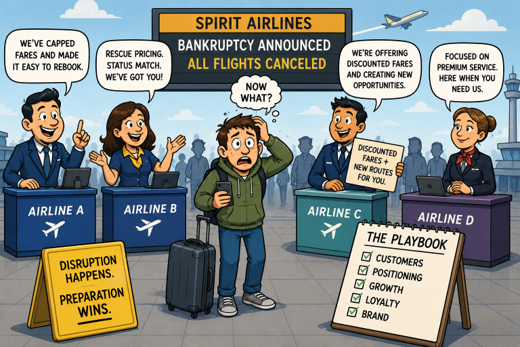
When Spirit Airlines abruptly declared bankruptcy and ceased operations, the immediate concern was understandably the stranded passengers. Thousands of travelers suddenly found themselves scrambling to get home and salvage canceled trips.
Within hours, competitors responded… United capped fares and created a dedicated booking process. Southwest offered simplified rescue pricing and status matching. JetBlue introduced discounted replacement fares while also recruiting displaced employees. Delta took a more measured approach that aligned with its premium positioning.
What stood out was how quickly they responded—and how differently they responded. Each airline appeared to have a playbook. While the tactics varied, every response reflected deliberate choices about customers, positioning, and growth. From the outside, that can look like luck. It wasn’t.
1. Most Companies Wait for Disruption. Airlines Can’t Afford To
Airlines operate in one of the world’s most disruption-prone industries. Weather events, fuel price shocks, labor disputes, regulatory changes, and competitive actions can alter the market overnight. As a result, contingency planning isn’t optional. Airlines don’t know exactly what disruption will occur next, but they know disruption will occur.
Most B2B companies operate differently. They focus on today’s priorities and assume they’ll figure things out when circumstances change. The Spirit Airlines bankruptcy suggests otherwise.
2. The Biggest Myth About Scenario Planning
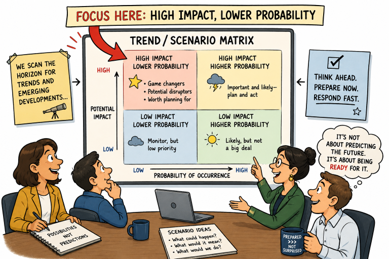
One of the most common misconceptions about scenario planning is that its purpose is prediction. It isn’t. The purpose is to identify events that could significantly impact your business and think through how you would respond if they occurred.
In our work, we often use trend analysis to identify developments that fall into a particularly important category: events that may have a lower probability of occurring but would have an outsized impact if they did. These are the situations that often occupy the upper-left portion of a trend matrix—high impact, lower probability.
Examples include:
- A major competitor going bankrupt
- A disruptive technology becoming viable
- A critical supplier failing
- A significant regulatory change
- A dramatic shift in customer buying behavior
Most of these don’t require immediate action, but they do require thought. The goal isn’t to predict which event will happen. The goal is to determine what you would do if something similar occurred. Most organizations never get that far. When leaders explain why, two reasons usually emerge: time and complexity. Teams are too busy to think about possibilities that may never happen, and there seem to be too many futures to consider. Both objections are understandable. Neither is particularly persuasive.
No organization can anticipate every possibility. But most can identify a small number of events that would dramatically affect their customers, competitors, suppliers, technologies, or business model—and determine in advance how they would respond. That preparation creates speed. And speed often creates advantage.
3. The Airlines Didn’t Plan for Spirit’s Bankruptcy
The airlines almost certainly did not have a scenario labeled “Spirit Airlines Bankruptcy. What they likely had were scenarios involving competitor exits, customer displacement, employee displacement, and sudden opportunities to gain market share.
In other words, they didn’t plan for the exact event. They planned for the category of event. That’s what makes scenario planning practical. You don’t need to predict the future perfectly. You need to identify situations that could reshape your market and develop plans for how you would respond.
4. What Looked Like Luck Was Actually Preparation
Years before COVID, our firm began noticing a trend toward more distributed and remote learning. The trend wasn’t moving particularly fast, but it was visible. We believed organizations would eventually want more flexibility in how workshops, training, and strategic planning sessions were delivered, so we invested in virtual facilitation capabilities before most organizations considered them necessary.
Then COVID arrived. We didn’t predict a global pandemic—just as the airlines didn’t predict Spirit’s bankruptcy. What we had anticipated was a category of event that would make in-person collaboration more difficult. Different event. Same consequence.
Suddenly, capabilities that once seemed premature became essential. From the outside, it looked like luck. From the inside, it was preparation meeting opportunity.
5. Why Business Luck Usually Isn’t Luck

Most business leaders underestimate how often preparedness gets mistaken for luck. The companies that seem unusually agile, resilient, or opportunistic are often not smarter than everyone else. They simply spent time considering possibilities before those possibilities became reality.
The Spirit Airlines bankruptcy offers a useful reminder. The airlines didn’t know exactly what would happen, when it would happen, or who would trigger it. But many appeared to have thought through the kinds of disruptions that could reshape their market and the actions they would take if those disruptions occurred.
That’s the real value of scenario planning. Not predicting the future. Being ready when it arrives.