
 Mary Abbazia
 Tom Spitale
Hidden in Plain Sight Series #5: Companies often know exactly what they’re good at. The bigger opportunity is discovering whether those are the things customers actually care about.
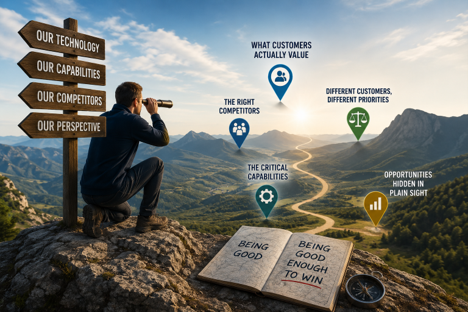
Most successful B2B technology companies are good at something. They may have outstanding engineering, superior performance, experienced people, or technology that objectively outperform competitors. Unfortunately, none of that guarantees they’ll win.
The problem is that companies naturally evaluate themselves using the things they know best. They compare themselves against familiar competitors, emphasize capabilities they’re proud of, and judge performance through their own expertise.
An Ability to Win analysis forces a very different perspective: What does the customer value, who else can deliver it, and how good are we at the things that actually determine who wins?
1. Your Biggest Competitor May Not Look Like a Competitor
Years ago, we worked with a company marketing a smoking-cessation product. When the team identified competitors, they naturally listed other products designed to help people quit. Then someone suggested adding another option: quitting “cold turkey”.
Initially, it hardly seemed like a competitor at all. It wasn’t a company, product, or technology. But when evaluated against what customers actually valued, cold turkey won by a landslide. It cost nothing, required no trip to the store, and allowed people to quit privately and on their own terms.
In hindsight, everyone could see it. Of course, doing it yourself was a competitor. Yet it didn’t appear until the team stopped defining competition from the company’s perspective and started defining it from the customers’ perspective.
That’s exactly how opportunities—and threats—hide in plain sight.
2. Customers Don’t Grade You on the Things You’re Proud Of

Another blind spot appears when companies choose the right competitors but the wrong criteria.
Technical organizations naturally gravitate toward technical capabilities. That’s where their expertise lives, and often where they’ve invested millions of dollars. But customers may be keeping a very different scorecard.
Consider what happened as Nvidia surged ahead of Intel in AI. The discussion wasn’t simply about who could produce the better semiconductor. The market increasingly valued an ecosystem—software, tools, partnerships, and technologies that worked together. Nvidia anticipated those changing requirements and built or partnered to create capabilities around them.
The lesson isn’t that technical performance stopped mattering. It’s that technical performance alone was no longer enough.
3. The Capabilities That Made You Successful Can Become a Blind Spot
This creates an uncomfortable question for established companies: What if the capabilities that made you successful aren’t the capabilities that will determine who wins next?
Markets change. Buying committees change. Customer expectations change. A capability that deserves a 10 (on a 10-point scale) today may matter far less three years from now, while something your organization currently does poorly becomes essential.
An honest competitive assessment therefore shouldn’t merely confirm existing strengths. It should expose the capabilities you don’t have—and force a decision about whether to build, buy, or partner to acquire them. Being a 3 (out of 10) today isn’t necessarily fatal. Believing you’re already good enough can be.
4. Sometimes There Isn’t One Ability to Win (ATW)
There’s another complication, particularly in B2B markets: different customers may define winning differently. A company in a risk-focused segment may heavily value trust, evidence, and reliability. A performance-focused customer may care more about productivity or technical results. Operational and economic buyers may prioritize entirely different outcomes than the technical buyer who has historically dominated the relationship.
Put all those customers into one analysis and you risk recreating the “lukewarm tea” problem we’ve discussed previously—averaging different needs until the result describes nobody particularly well.
The more revealing question is often: Which customers are we especially equipped to win? You may discover that your company is mediocre against one segment’s priorities but exceptionally strong against another’s. That insight can completely change where you put your resources.
5. Stop Asking Whether You’re Good

Most organizations already know their strengths. What they don’t always know is whether customers value those strengths enough to choose them over every other alternative.
That’s the discipline behind Ability to Win: choose competitors from the customer’s perspective, identify the benefits and capabilities that truly drive choice, evaluate performance honestly, and recognize that different customers may produce very different scorecards. Once you do, the answer can seem painfully obvious.
The competitor you overlooked. The capability you never built. The customer segment you should have pursued all along. They weren’t invisible. You were simply looking at the market through your own scorecard instead of the customer’s.
Related Posts
-
In this episode, the team explores why growth in B2B doesn’t always come from adding…
-

How to turn strategy tools into stories that are relatable, memorable, and fast to build…
-

Turn Your Company's Notion of Marketing Metrics On Its Side Most companies take too narrow…